Welcome to The Agent Roundup | Voice AI is evolving fast, and the architecture you choose can make or break user experience. In this edition, we break down the pros, cons, and trade-offs to help you decide which approach fits your strategy for speed, flexibility, and scalability. | This week’s topics: | OpenAI’s real-time voice AI updates Alibaba’s automation frameworks New agents for coding and in-browser use Voice AI architecture decisions
|
|
| | OpenAI Releases gpt-realtime Model and Realtime API Updates | OpenAI has made its Realtime API generally available, featuring the advanced gpt-realtime speech-to-speech model. | This release includes remote MCP server support, image inputs, and SIP phone calling support, enabling developers to build more reliable and capable production voice agents that process and generate audio directly through a single model. | Alibaba Qwen Team Unveils Next-Generation GUI Automation Frameworks | Alibaba's Qwen team introduced Mobile-Agent-v3 and GUI-Owl, revolutionary products designed to tackle challenges in graphical user interface (GUI) automation. | GUI-Owl is a multimodal agent model that integrates perception, reasoning, planning, and execution for complex GUI environments, while Mobile-Agent-v3 focuses on multi-agent collaboration to break down complex tasks and dynamically update plans. | Anthropic Launches Claude AI Agent for Chrome | Anthropic has released a research preview of a browser-based AI agent powered by its Claude AI models for select subscribers. | This agent allows users to chat with Claude within their browser, maintaining context and offering the ability to take actions and complete tasks on their behalf, though Anthropic warns of new safety risks and has implemented defenses against prompt injection attacks. | xAI Releases grok-code-fast-1 for Agentic Coding | xAI introduced grok-code-fast-1, a speedy and economical reasoning model optimized for agentic coding workflows. | This model excels at common tools like grep and terminal, supporting various programming languages. | More Market Updates | System Initiative integrates AI agents into infrastructure automation. | Crisp introduces AI agent studio for retail performance. | Hyland debuts Enterprise Context Engine and Agent Mesh. | HPE accelerates self-driving networks with Mist Agentic AI. | Google Gemini now available on-premises. | Auditoria.AI adds new AI agent for financial planning and analysis. | Akka launches agentic platform in partnership with Deloitte. | C3.ai unveils "C3 Agentic AI Websites". | Linux Foundation welcomes Agentgateway project to accelerate AI agent adoption. | IDC forecasts agentic AI to dominate IT spend by 2029. | Salesforce AI research advances agentic enterprise readiness. | Meta explores integrating Google and OpenAI models. | | Real-World ROI | Walmart's 2025 AI-driven transformation, utilizing agentic AI tools like Sparky (customer agent), VizPick (AR inventory), and Marty (supplier agent), has slashed labor costs by 50%, enabled 93% U.S. same-day delivery coverage, and reduced refrigeration expenses by 19%. | A Fortune 500 manufacturing company that implemented generative AI in its analytics platform achieved a 50% reduction in report generation time and a 40% increase in user engagement with analytics tools. The system now automatically generates weekly performance reports with contextual insights and recommendations, leading to faster decision-making. | JPMorgan Chase uses COIN to analyze legal documents for fraud faster and more accurately than manual processes. | BlackRock's Aladdin platform utilizes LLMs to analyze market trends and calculate risk for $10 trillion in assets, processing thousands of data points daily. | Bank of America's virtual assistant Erica handles over one billion customer interactions annually, providing personalized financial tips and transaction assistance. | | Advanced AI Agent Tools | | 1. Autonomy Levels (A1–A7): Defines different degrees of AI autonomy based on human involvement, from 'Operator' (human decides, AI drafts) to 'Outsider' (humans relinquish full control). | 2. Risk Tiers (R1–R4): Categorizes systems based on potential external exposure, legal impact, irreversibility, and public impact (R4 being the highest risk). | 3. Control Packs (C1–C3): Suggests pre-bundled guardrails and safety recommendations for each risk tier, building upon each other (e.g., action/conversation logs, human-readable rationale, calibrated confidence, rollback planning, multi-phase approvals for irreversible steps). | 4. Capability Grades (CG1–CG3): Measures an agent's autonomy against verified competence and reliability (Pilot-Grade, Production-Grade, High-Stakes), with evaluation criteria covering policy adherence, task performance, uncertainty calibration, explainability, and adversarial robustness. | | Create How-to Videos in Seconds with AI | | Stop wasting time on repetitive explanations. Guidde’s AI creates stunning video guides in seconds—11x faster. | Turn boring docs into visual masterpieces Save hours with AI-powered automation Share or embed your guide anywhere
| How it works: Click capture on the browser extension, and Guidde auto-generates step-by-step video guides with visuals, voiceover, and a call to action. | Best part? It’s 100% free. | 👉 Download the extension now |
|
| | | Speech-to-Speech vs. Pipeline: The Voice AI Architecture Decision |
| | |
|  | The Agent Roundup / gpt |
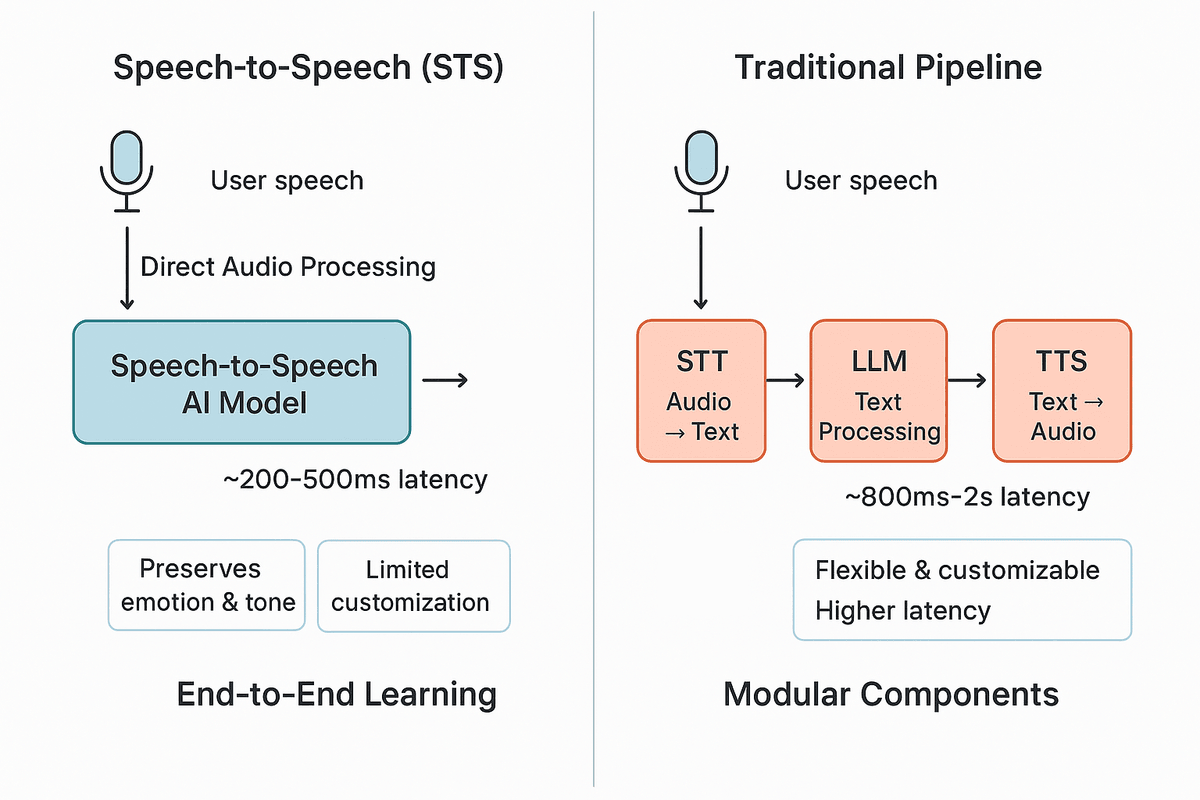
| The “AI part” of voice agents usually consists of three components: | A speech-to-text model that receives recorded audio from the user and converts it to text. You could call this step transcription. The transcribed text is then processed by a large language model. The LLM generates a response text. E.g., user asks “where is my order?”. LLM looks up order information (tool use) and replies. The LLM response is converted back to speech using a text-to-speech model. The audio is played.
| An alternative, much simpler approach is using a speech-to-speech model. This basically combines all three steps into one. The model receives audio and responds with audio while doing the computation. | Stick with the proven STT→LLM→TTS pipeline or deploy speech-to-speech (STS) models? Here are some nuances you should consider: | Speech-to-Speech (STS) Models | Pros: | Superior conversational flow - Handles interruptions, overlapping speech, and natural speech patterns apart from text (like a laugh) Emotional intelligence - Preserves tone, inflection, and vocal cues for more empathetic customer interactions Reduced latency - Direct audio processing is much faster because it eliminates multi-step delays Multilingual voice consistency - It can switch languages mid-sentence while maintaining speaker tone and pacing
| Cons: | Limited customization - At the moment, there are fewer voice options and minimal brand voice alignment compared to mature TTS libraries Restricted language support - Currently supports far fewer languages and regional accents than established TTS systems Vendor lock-in risk - End-to-end systems prevent swapping LLM components or TTS engines Deployment constraints - Often cloud-dependent with limited on-premise options for data-sensitive industries
| STT + LLM + TTS Pipeline | Pros: | Maximum flexibility - Swap OpenAI for Claude, change voice engines, or update STT models independently Comprehensive language coverage - 100+ languages with extensive dialect and accent support Enterprise-ready - Proven reliability with separate optimization of each component Voice customization - Extensive libraries for brand-aligned voice selection and fine-tuning
| Cons: | Higher latency - Multi-step processing creates noticeable delays in conversation flow Lost emotional context - Text intermediary strips away vocal nuance, resulting in less expressive responses Complex integration - Multiple vendors and APIs to manage, increasing technical debt Conversational deficits - Struggles with natural speech irregularities like hesitations or background noise
| Conclusion | STS is great for consumer-facing applications that prioritize user experience. It also shines in use cases where emotional intelligence drives engagement and real-time applications that require fast response times. | The pipeline approach is better for deployments requiring specific LLM capabilities and multi-language applications with broad geographic coverage, extensive voice customization, or brand alignment. With a range of open-source solutions, it’s currently easier to meet strict data sovereignty requirements. |
|
| |  | Poonam Soni @CodeByPoonam |  |
| |
How to build your first AI agent (Full guide) | |  | | | 9:45 AM • Aug 24, 2025 | | | | | | 2.69K Likes 371 Retweets | 48 Replies |
|
|
|
|  | Andrew Ng @AndrewYNg | |
| |
Build better RAG by letting a team of agents extract and connect your reference materials into a knowledge graph. Our new short course, “Agentic Knowledge Graph Construction,” taught by @neo4j Innovation Lead @akollegger, shows you how. Knowledge graphs are an important way to | |  | | | 3:51 PM • Aug 27, 2025 | | | | | | 2.35K Likes 421 Retweets | 56 Replies |
|
|
|
| | Blog: In-depth articles on AI workflows and practical strategies for growth
AI Tool Collection: Discover and compare validated AI solutions
Consultancy: Explore AI potential or make your team AI-fit
Agency: Production-ready AI implementation services |
|
| | |
|